Posts
Posts


Wednesday, January 13, 2010
Winning Funding Strategies for Producers
Many articles have been written about ways of funding independent film projects, some of them good, some of them not so good. But here's an article that in addition to being an entertaining read offers some interesting ideas for ways to creatively raise money to fund your next project.
Read the Article
Regardless of which of these you may decide to incorporate into your next fundraising plan, always remember to check with an attorney to be sure that your in compliance with all related laws.
Happy Fundraising!


Thursday, December 17, 2009
Greg Steiner Receives 2009 Emmy Award

Fort Lauderdale, Florida - December 5, 2009 – Local producer and sound engineer Greg Steiner has held many titles during his 23 years in the entertainment industry: musician, recording engineer, record producer, and film director to name just a few. But now he can proudly add one more to the list: Emmy winner.
This past weekend at the 2009 Suncoast Emmy Awards in Orlando, Florida, Mr. Steiner took the stage to receive his first Emmy award in the category of “Audio: Live Sound or Post Production” for his sound design contribution to the Becon-TV produced educational series “Science and Me.”
“It was a great thrill to be honored alongside some of South Florida’s most talented production professionals,” says Mr. Steiner, “and to have my work recognized by the Academy.” Florida news legends Dwight Lauderdale and Tony Segreto were both honored with the Academy’s Governor’s Award at the same ceremony.
Mr. Steiner started his career as a musician at the age of fourteen. After high school, he attended the prestigious Berklee College of Music, in Boston, Massachusetts where he graduated Cum Laude with a Bachelor’s degree in Music Production and Engineering.
Shortly after graduation he relocated to Fort Lauderdale, Florida and built Q Station, a state of the art recording studio and post-production facility (http://www.q-station.com). In 2006, Mr. Steiner produced and directed his first feature length comedy, Bumping off Burt, which is currently awaiting distribution (www.bumpingoffburt.com).
So what’s next for this Emmy winner?
“A little bit of this and a little bit of that.” jokes Steiner. “We have several other film projects in development and a number of commercial projects ready to move into production. Plus, we’ve just completed a business plan for an authentic Irish Pub concept that we’re preparing to present to investors.”
Sunday, October 25, 2009
Greg Steiner nominated for a 2009 Emmy Award

Producer, Director, Audio Engineer, and Q Station founder Greg Steiner received a nomination for a 2009 Emmy award for Sound Design for his work on the BECON TV educational science program "Science Matters". The Award ceremony will take place in Orlando on December 5th, 2009.
Saturday, September 5, 2009
So You Wanna Work in Movies?
Well, it's been quite a while since my last post to this blog. But rest assured, I haven't forgotten about you all! Sometimes life gets in the way, other priorities take precedence, and I just can't seem the time to do all of the things I'd like to do!
A few weeks ago, fellow South Florida filmmaker Alex Ferrari of Numb Robot, send me the link to a very interesting article by British DP Oliver Stapleton. In essence, it's a very detailed response to all the people who want to know: What do I do to get into Movies?

Oliver Stapleton BSC
Since the article is too long to post here in it's entirety, I've decided to simply provide the link so that you can read it for yourself at your leisure:
Enjoy!
Wednesday, January 14, 2009
Music Licensing: Exclusive vs. Non Exclusive Contracts
First of all it's important to understand that any given song can only have one publisher that represents it at a given time. It's either going to be you, or it's going to be a third party in the event that you sign away your publishing rights to someone else.
A lot of writers are understandably reluctant to sign exclusive contracts with publishers. I can understand and relate to this reluctance, but to fully appreciate the issue it's important to consider the point of view and the role of the music publisher in the context of music licensing.
Music publishers make their living by developing relationships with music supervisors, ad agencies and the like, as well as the songwriters whose music they represent. Based on my own recent personal experiences with my new music marketing company I can assure you that this is very hard and competitive work. In order for successful music publishing companies to make a name for themselves, they like to have a unique catalog to present to the licensing community. If all catalogs were the same there would be no incentive for someone to do business with one publisher vs another.
The analogy I often make is that it's similar to the way music retailers operate with the manufacturers they represent. There are geographic restrictions that allow music retailers to carry instruments and equipment that can't be found within a certain proximity to a retailer's location. It's the same principle at work. If you could simply walk into any one of a dozen stores in the same town and find the exact same type of gear there would be little incentive to do business with one store over another and retailers would have much less leverage in the marketplace.
So the question remains. Should you or shouldn't you sign exclusive contracts? I always advise writers to assess several factors when making a decision. First of all, what other offers do you have on the table? And secondly, if you are offered an exclusive contract, what is the track record of the company that is offering you the deal? Are they a fairly new company with few credits or are they an established company with a verifiable track record of placing music in TV, Film, etc.? If the latter is the case it would probably make sense to take a chance and sign a couple of your songs. You can always negotiate for a contract that releases the publishing rights back to you after a finite period of time. For example, one to two years. Also keep in mind that if you are a prolific writer, and you should be if you're pursuing licensing opportunities you will always be writing new material that you can place with other companies as well.
Over a year ago I created a one of a kind program that teaches musicians, in a step by step fashion, how to license their music for use in TV, Films and even Video Games. This program took me several months to develop and is based on my own personal experiences of licensing my own music for the last six years. My program is called The A-Z Of Music Licensing and it includes EVERYTHING you need to know to begin the process of successfully licensing your music. It even includes a directory of contact information for the music licensing industry so you'll know who to contact. The program is a digital product that contains both an audio and PDF portion. I also offer the program with additional email coaching if you feel like you need extra support in getting started. My service, to the best of my knowledge, is the only service of its kind for musicians interested in entering into this exciting business.

Monday, December 1, 2008
November's Giveaway Winner Announced!
First off, I'd like to thank everyone who participated in our Autographed Movie Poster giveaway for the month of November. We received a wonderful response to this promotion and we appreciate all of your e-mails and kind words.
All entries received were indexed numerically in the order in which they were received and added to a master list. Persons with multiple entries appear on the master list multiple times, once for each indexed entry. At 11:24 pm, on December 1, 2008 an indexed entry was selected at random using the random integer generator at random.org.
The winner of November's giveaway for an official Bumping off Burt movie poster autographed by the director and members of the cast is:
BLUVIOLET
Congratulations to our winner!
Don't forget to send us an e-mail at info@q-station.com with your full name and mailing address and we'll get the poster packaged and shipped out to you as quickly as possible.
For those who didn't win this time, keep checking back as we plan on having some other great giveaways in the months ahead I'm sure you won't want to miss!
Tuesday, November 25, 2008
Kentucky Voicing: Not Just for Audio
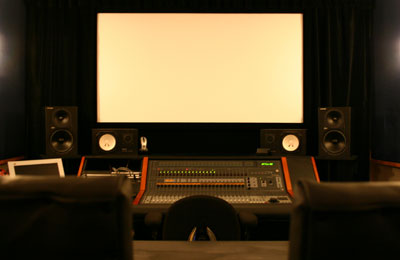 When I was a student at Berklee College of Music, I had the opportunity to work with many highly trained and experienced sound engineers who helped to shape the course of my career. One of those individuals was Dave Moulton, who at the time was the Chair of the Music Production and Engineering department.
Though there were many brilliant gems of audio wisdom which Dave shared with his students, one in particular which stands out in my mind was something Dave referred to as "Kentucky Voicing".
In theory, every recording or audio mix should be performed in an ideal acoustical environment... one which allows you to hear the sound as it was originally captured during recording. But in the real world, there really is no "ideal" environment. The acoustic quality of rooms can vary from studio to studio and even from day to day, speakers can alter the sound of a recording, and budgets often necessitate using less than perfect equipment which can add noise or worse into the environment. All of these factors can influence your mix.
Kentucky Voicing is a technique which can help you compensate for these factors and create consistent audio mixes by minimizing the effect of the equipment and environment on your decision making process during a mix. In essence, you use familiar recordings to create a "baseline" by which to judge your own mixes.
Here's how Dave Moulton describes the process of applying Kentucky Voicing to your own work:
"First adopt a monitor that you can live with. This means (a) that you can afford it, (b) you can stand listening to it for extended periods of time, and (c) you find that you actually enjoy listening to your favorite recordings on it.
Second, thoroughly 'learn' at least five or six of your favorite recordings (at least) on this speaker system. Choose well-known and successful recordings (Steely Dan, for instance). Memorize 'the way they sound.' When mixing your own work, work towards emulating 'the way they sound' on your speaker system. This will give your recordings the best chance of sounding good over many different loudspeakers.
Third, when working on monitors other than your own, take along your 'reference' recordings and play them first, before you work on your own material. Get 'the way they sound' in your ears, and, to repeat, mix toward that sound quality. If your reference recordings sound bass-heavy, for instance, mix your own work bass-heavy. This will tend to neutralize the effect of the colorations of the different monitors on your work."
Applying the concepts of Kentucky Voicing to Images
When I first began working in film and video, I found that many of the tips and tricks I'd learned in the audio field could be applied to visual arts as well with a bit of adaptation and Kentucky Voicing was one of the first concepts I carried over.
In both film and video, footage is often color corrected as the last step in the production process before the project is distributed and/or broadcast. It's during this phase of production where the final contrast and brightness of the footage is determined, blacks are made black, whites are made white, and images are tweaked to create the perfect natural or stylized look.
Ask any colorist or television engineer and they'll tell you to NEVER attempt to color correct or balance images without using a calibrated broadcast monitor and video scope. But what if you can't afford to purchase a nice expensive calibrated broadcast monitor and video scope which can run well over ten thousand dollars? If you have to make do with a consumer television or computer monitor as your primary color correction monitor, why not apply the same techniques used in Kentucky Voicing to your images as well? Keeping with our theme, let's call it "Kentucky Viewing".
(Incidentally, I have no idea what any of these techniques have to do with Kentucky. The term was originally coined by Dave Moulton, and if I remember correctly, the technique just needed a name for descriptive purposes and it seemed as good a name as any. It does have a nice ring to it, doesn't it?)
First I would try to get your selected monitor as close to "calibrated" as possible. Some monitors and televisions have more controls than others, but at a minimum, you should be able to set the brightness, contrast, and hue to get the image in the ball park. I would strongly recommend using color bars to make your adjustments, but at the very least, find footage of something you know to be pure white and use that image to remove any color casts in the image.
Then, before you begin correcting any footage, pull out a few of your favorite movies or television shows and spend some time watching them on the monitor you've chosen. Notice the details in the image. How black are the blacks? How bright are the whites? Are white objects really pure white, or do they have a slight color cast?
Once you have a good idea what your favorite images look like on your work monitor, take a shot at color correcting your own footage using the same monitor. Try and make your images look like your reference footage. If you can, grab a still frame from your reference footage and keep it handy to use as a comparison.
On more than one occasion I've used this technique on my own projects and have had excellent results. Just keep in mind that if you're planning on broadcasting your project, you'll still need to view the final product on a scope to make sure your black levels and white levels are broadcast legal. This method is not designed to replace a calibrated monitor and scope, just like Kentucky Voicing is not designed to replace a well designed studio listening environment. It's just an extra tool you can use to help get the job done in a pinch.
If you'd like to read some of Dave Moulton's other gems of wisdom, you can do so at his company website at http://www.moultonlabs.com/
Subscribe to:
Posts (Atom)