Posts
Posts


Wednesday, January 13, 2010
Winning Funding Strategies for Producers
Many articles have been written about ways of funding independent film projects, some of them good, some of them not so good. But here's an article that in addition to being an entertaining read offers some interesting ideas for ways to creatively raise money to fund your next project.
Read the Article
Regardless of which of these you may decide to incorporate into your next fundraising plan, always remember to check with an attorney to be sure that your in compliance with all related laws.
Happy Fundraising!


Thursday, December 17, 2009
Greg Steiner Receives 2009 Emmy Award

Fort Lauderdale, Florida - December 5, 2009 – Local producer and sound engineer Greg Steiner has held many titles during his 23 years in the entertainment industry: musician, recording engineer, record producer, and film director to name just a few. But now he can proudly add one more to the list: Emmy winner.
This past weekend at the 2009 Suncoast Emmy Awards in Orlando, Florida, Mr. Steiner took the stage to receive his first Emmy award in the category of “Audio: Live Sound or Post Production” for his sound design contribution to the Becon-TV produced educational series “Science and Me.”
“It was a great thrill to be honored alongside some of South Florida’s most talented production professionals,” says Mr. Steiner, “and to have my work recognized by the Academy.” Florida news legends Dwight Lauderdale and Tony Segreto were both honored with the Academy’s Governor’s Award at the same ceremony.
Mr. Steiner started his career as a musician at the age of fourteen. After high school, he attended the prestigious Berklee College of Music, in Boston, Massachusetts where he graduated Cum Laude with a Bachelor’s degree in Music Production and Engineering.
Shortly after graduation he relocated to Fort Lauderdale, Florida and built Q Station, a state of the art recording studio and post-production facility (http://www.q-station.com). In 2006, Mr. Steiner produced and directed his first feature length comedy, Bumping off Burt, which is currently awaiting distribution (www.bumpingoffburt.com).
So what’s next for this Emmy winner?
“A little bit of this and a little bit of that.” jokes Steiner. “We have several other film projects in development and a number of commercial projects ready to move into production. Plus, we’ve just completed a business plan for an authentic Irish Pub concept that we’re preparing to present to investors.”
Sunday, October 25, 2009
Greg Steiner nominated for a 2009 Emmy Award

Producer, Director, Audio Engineer, and Q Station founder Greg Steiner received a nomination for a 2009 Emmy award for Sound Design for his work on the BECON TV educational science program "Science Matters". The Award ceremony will take place in Orlando on December 5th, 2009.
Saturday, September 5, 2009
So You Wanna Work in Movies?
Well, it's been quite a while since my last post to this blog. But rest assured, I haven't forgotten about you all! Sometimes life gets in the way, other priorities take precedence, and I just can't seem the time to do all of the things I'd like to do!
A few weeks ago, fellow South Florida filmmaker Alex Ferrari of Numb Robot, send me the link to a very interesting article by British DP Oliver Stapleton. In essence, it's a very detailed response to all the people who want to know: What do I do to get into Movies?

Oliver Stapleton BSC
Since the article is too long to post here in it's entirety, I've decided to simply provide the link so that you can read it for yourself at your leisure:
Enjoy!
Wednesday, January 14, 2009
Music Licensing: Exclusive vs. Non Exclusive Contracts
First of all it's important to understand that any given song can only have one publisher that represents it at a given time. It's either going to be you, or it's going to be a third party in the event that you sign away your publishing rights to someone else.
A lot of writers are understandably reluctant to sign exclusive contracts with publishers. I can understand and relate to this reluctance, but to fully appreciate the issue it's important to consider the point of view and the role of the music publisher in the context of music licensing.
Music publishers make their living by developing relationships with music supervisors, ad agencies and the like, as well as the songwriters whose music they represent. Based on my own recent personal experiences with my new music marketing company I can assure you that this is very hard and competitive work. In order for successful music publishing companies to make a name for themselves, they like to have a unique catalog to present to the licensing community. If all catalogs were the same there would be no incentive for someone to do business with one publisher vs another.
The analogy I often make is that it's similar to the way music retailers operate with the manufacturers they represent. There are geographic restrictions that allow music retailers to carry instruments and equipment that can't be found within a certain proximity to a retailer's location. It's the same principle at work. If you could simply walk into any one of a dozen stores in the same town and find the exact same type of gear there would be little incentive to do business with one store over another and retailers would have much less leverage in the marketplace.
So the question remains. Should you or shouldn't you sign exclusive contracts? I always advise writers to assess several factors when making a decision. First of all, what other offers do you have on the table? And secondly, if you are offered an exclusive contract, what is the track record of the company that is offering you the deal? Are they a fairly new company with few credits or are they an established company with a verifiable track record of placing music in TV, Film, etc.? If the latter is the case it would probably make sense to take a chance and sign a couple of your songs. You can always negotiate for a contract that releases the publishing rights back to you after a finite period of time. For example, one to two years. Also keep in mind that if you are a prolific writer, and you should be if you're pursuing licensing opportunities you will always be writing new material that you can place with other companies as well.
Over a year ago I created a one of a kind program that teaches musicians, in a step by step fashion, how to license their music for use in TV, Films and even Video Games. This program took me several months to develop and is based on my own personal experiences of licensing my own music for the last six years. My program is called The A-Z Of Music Licensing and it includes EVERYTHING you need to know to begin the process of successfully licensing your music. It even includes a directory of contact information for the music licensing industry so you'll know who to contact. The program is a digital product that contains both an audio and PDF portion. I also offer the program with additional email coaching if you feel like you need extra support in getting started. My service, to the best of my knowledge, is the only service of its kind for musicians interested in entering into this exciting business.

Monday, December 1, 2008
November's Giveaway Winner Announced!
First off, I'd like to thank everyone who participated in our Autographed Movie Poster giveaway for the month of November. We received a wonderful response to this promotion and we appreciate all of your e-mails and kind words.
All entries received were indexed numerically in the order in which they were received and added to a master list. Persons with multiple entries appear on the master list multiple times, once for each indexed entry. At 11:24 pm, on December 1, 2008 an indexed entry was selected at random using the random integer generator at random.org.
The winner of November's giveaway for an official Bumping off Burt movie poster autographed by the director and members of the cast is:
BLUVIOLET
Congratulations to our winner!
Don't forget to send us an e-mail at info@q-station.com with your full name and mailing address and we'll get the poster packaged and shipped out to you as quickly as possible.
For those who didn't win this time, keep checking back as we plan on having some other great giveaways in the months ahead I'm sure you won't want to miss!
Tuesday, November 25, 2008
Kentucky Voicing: Not Just for Audio
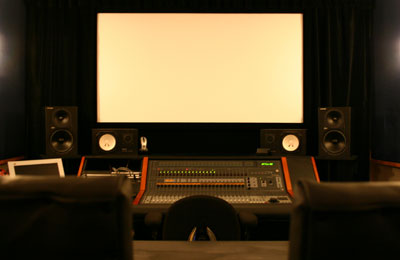 When I was a student at Berklee College of Music, I had the opportunity to work with many highly trained and experienced sound engineers who helped to shape the course of my career. One of those individuals was Dave Moulton, who at the time was the Chair of the Music Production and Engineering department.
Though there were many brilliant gems of audio wisdom which Dave shared with his students, one in particular which stands out in my mind was something Dave referred to as "Kentucky Voicing".
In theory, every recording or audio mix should be performed in an ideal acoustical environment... one which allows you to hear the sound as it was originally captured during recording. But in the real world, there really is no "ideal" environment. The acoustic quality of rooms can vary from studio to studio and even from day to day, speakers can alter the sound of a recording, and budgets often necessitate using less than perfect equipment which can add noise or worse into the environment. All of these factors can influence your mix.
Kentucky Voicing is a technique which can help you compensate for these factors and create consistent audio mixes by minimizing the effect of the equipment and environment on your decision making process during a mix. In essence, you use familiar recordings to create a "baseline" by which to judge your own mixes.
Here's how Dave Moulton describes the process of applying Kentucky Voicing to your own work:
"First adopt a monitor that you can live with. This means (a) that you can afford it, (b) you can stand listening to it for extended periods of time, and (c) you find that you actually enjoy listening to your favorite recordings on it.
Second, thoroughly 'learn' at least five or six of your favorite recordings (at least) on this speaker system. Choose well-known and successful recordings (Steely Dan, for instance). Memorize 'the way they sound.' When mixing your own work, work towards emulating 'the way they sound' on your speaker system. This will give your recordings the best chance of sounding good over many different loudspeakers.
Third, when working on monitors other than your own, take along your 'reference' recordings and play them first, before you work on your own material. Get 'the way they sound' in your ears, and, to repeat, mix toward that sound quality. If your reference recordings sound bass-heavy, for instance, mix your own work bass-heavy. This will tend to neutralize the effect of the colorations of the different monitors on your work."
Applying the concepts of Kentucky Voicing to Images
When I first began working in film and video, I found that many of the tips and tricks I'd learned in the audio field could be applied to visual arts as well with a bit of adaptation and Kentucky Voicing was one of the first concepts I carried over.
In both film and video, footage is often color corrected as the last step in the production process before the project is distributed and/or broadcast. It's during this phase of production where the final contrast and brightness of the footage is determined, blacks are made black, whites are made white, and images are tweaked to create the perfect natural or stylized look.
Ask any colorist or television engineer and they'll tell you to NEVER attempt to color correct or balance images without using a calibrated broadcast monitor and video scope. But what if you can't afford to purchase a nice expensive calibrated broadcast monitor and video scope which can run well over ten thousand dollars? If you have to make do with a consumer television or computer monitor as your primary color correction monitor, why not apply the same techniques used in Kentucky Voicing to your images as well? Keeping with our theme, let's call it "Kentucky Viewing".
(Incidentally, I have no idea what any of these techniques have to do with Kentucky. The term was originally coined by Dave Moulton, and if I remember correctly, the technique just needed a name for descriptive purposes and it seemed as good a name as any. It does have a nice ring to it, doesn't it?)
First I would try to get your selected monitor as close to "calibrated" as possible. Some monitors and televisions have more controls than others, but at a minimum, you should be able to set the brightness, contrast, and hue to get the image in the ball park. I would strongly recommend using color bars to make your adjustments, but at the very least, find footage of something you know to be pure white and use that image to remove any color casts in the image.
Then, before you begin correcting any footage, pull out a few of your favorite movies or television shows and spend some time watching them on the monitor you've chosen. Notice the details in the image. How black are the blacks? How bright are the whites? Are white objects really pure white, or do they have a slight color cast?
Once you have a good idea what your favorite images look like on your work monitor, take a shot at color correcting your own footage using the same monitor. Try and make your images look like your reference footage. If you can, grab a still frame from your reference footage and keep it handy to use as a comparison.
On more than one occasion I've used this technique on my own projects and have had excellent results. Just keep in mind that if you're planning on broadcasting your project, you'll still need to view the final product on a scope to make sure your black levels and white levels are broadcast legal. This method is not designed to replace a calibrated monitor and scope, just like Kentucky Voicing is not designed to replace a well designed studio listening environment. It's just an extra tool you can use to help get the job done in a pinch.
If you'd like to read some of Dave Moulton's other gems of wisdom, you can do so at his company website at http://www.moultonlabs.com/
Tuesday, November 18, 2008
Color Temperature: When "white" isn't just white.
The short answer is no. Now, here's the longer answer:
You may remember from elementary school that white is defined as the presence of all color. This was usually demonstrated by taking a white light and shining it through a prism to create a lovely little rainbow. This is the same reason rainbows often appear on sunny days through mists of water hanging in the air.
In order for an object to appear to be white, it must reflect back all of the colors contained within the light that is reflecting off it's surface. If one or more of the colors of the spectrum are missing from either the light source or the reflected light, the object will appear to have a color. The color of an object is determined mainly by the light source illuminating the object.
This is where color temperature comes into the equation. Marketing departments like to describe color temperatures using terms like "cool white" or "warm white", but in film and video, these terms are just not specific enough for our purpose. Instead, we describe the temperature of a light in degrees Kelvin.
The Kelvin Scale
If you've taken a high school chemistry or astronomy class, you may already be familiar with the kelvin scale. Technically speaking, it is a thermodynamic temperature scale, and one of the SI base units from which all other units of measurements can be derived. (For the technically curious, the other SI base units are meter, kilogram, second, ampere, mole and candela.)
The most commonly known temperature on the kelvin scale (noted with the symbol "K") is zero degrees kelvin, also known as Absolute Zero. This is the theoretical temperature at which there is no thermal energy and all life ceases to exist. But from a lighting standpoint, the low end of the kelvin scale doesn't concern us. We are interested in much higher temperatures... mostly those in the 1800K to 5600K range.
Temperature = Color
Looking up into the sky on a clear starry night you will notice that no two stars are exactly the same color. This is because no two stars burn at exactly the same temperature. Our own star Sol (aka. The Sun) is estimated to have a surface temperature of approximately 5,600K. Sirius, the brightest star in the Orion constellation has a temperature of approximately 9,800K and appears blue while Antares, the brightest star in Scorpio, appears red and has a temperature of 3,400K.
Rather than going through mathematical formulas and extensive data, let's just simplify the issue and say that lower temperatures will give the light a red hue, while higher temperatures will appear more blue. The hotter something burns, the more blue it appears. The cooler it burns the more red it will appear.
Keeping with this concept, lighting manufacturers rate their lights based on color temperature. A light with a color temperature of 5,600K is said to be a "cool white" or "sunlight balanced", whereas a tungsten light bulb has a temperature of 3,200K. Fluorescent lights, which often appear with a greenish tint have an approximate color temperature of 4,600K.

It's important to note that these are color temperatures not actual temperatures. In other words, the color of the light approximates the color of a star burning at a certain temperature Kelvin. Obviously, the light bulbs in your house are not as hot as the star Antares...
Determining What "White" Looks Like
Taking into account the light source shining on an object, we can see that changes in the color of the light will affect the color of a "white" object. A "white" piece of paper in direct sunlight will appear more "blue" than the same piece of paper lit by candlelight.
Fortunately (or unfortunately depending on how you look at the problem) the human brain has an automatic compensation device built in to eliminate these inconsistencies. If you look at a white piece of paper outside, it looks... well... white. Take the same piece of paper inside and look at it under a tungsten light bulb and it still looks white. Your brain continuously adjusts itself to take lighting conditions into account when determining color.
If you're bored one night and want to see this effect in action, try the following: Turn off all the lights in your house and turn on a TV set in a room with a window. Now, go outside and wait a few minutes for your eyes to adjust. If you look back at your house, you'll see an eerie blue glow coming from the room with the TV set. Go back inside and everything looks normal.
Cameras and White Balance
Since film and video cameras don't have the advantage of containing a human brain, we need to take these issues into account and tell the camera what it should see as white. We do this by choosing an appropriate film stock (daylight or tungsten) or white balancing the video camera for a certain light temperature. Then, make sure that all of the light sources that are being used match the camera white balance settings. Pick one color temperature and make sure everything is matched.
To help keep things balanced, there are also a number of different filters and gels available to help convert one color temperature of light to another. For example, if you are shooting in an apartment with one window, you can light the scene with tungsten (3200K) and can cover the window with a #85 gel to convert the sunlight (5,600K) to match the tungsten lights. Alternatively, you can put some CTB gels on your tungsten lights to bring their color temperature closer to that of sunlight. It all depends on your goals for lighting the scene.
If we don't give the camera a specific color temperature reference, or worse yet, use different color temperatures of light you will get some rather unexpected results. Your brain may be able to deal with multiple color temperatures of light, but cameras can not.
Monday, November 17, 2008
New Video releases "4th Dimension" through Apple iTunes

New Video has recently released 4th Dimension, a grainy, fun indie film on iTunes.
According to Jessica Trusiani of New Video, 4th Dimension "...explores the dark world between dreams and reality. Jack is an antique shop worker who becomes obsessed with analyzing time after finding Albert Einistein's journal on his unsolved Unified Field Theory."
You can visit iTunes to preview or download the film by clicking here.
For more information about the film or New Video's other releases, contact Jessica Trusiani at New Video, 902 Broadway, New York, NY 10010.
Sunday, November 9, 2008
"Bumping off Burt" Receives Finishing Touches Before Release
 After nearly three years in production, Q Station's debut feature length comedy Bumping off Burt is receiving a few last minute finishing touches before it's anticipated release in early 2009.
Written by acclaimed mystery novelist Malcolm McClintick, Bumping off Burt is the story of a group of friends and patrons of "Duffy's Diner" who, after months of dealing with the gross antics of Burt, decide the only way to rid themselves of this menace is murder. When the inept hit man they hire turns up missing, the group decides to take matters into their own hands.
The film went into pre-production in the spring of 2006 and filmed over a period of twenty-one days later that summer. Post production began on the film in late September and continued for more than a year. On February 5th, 2007, the film held it's first test screening for more than 200 invited guests at the historic Cinema Paradiso theater in downtown Fort Lauderdale, Florida.
During it's initial screening the film tested very well, achieving 72% in the "top two boxes" with more than 91% of the respondents indicating they would "definitely recommend the film to a friend." According to Robert Marich in his book Marketing to Moviegoers, films which score less than 55-65% are generally a cause for worry in Hollywood. If the initial audience response and screen test are any indication, Bumping off Burt is in the clear.
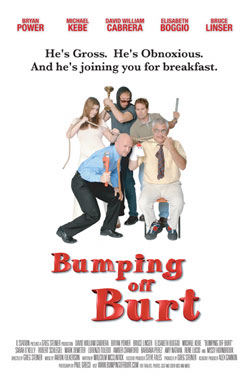 As with any successful film, Bumping off Burt only exists because of the hard work and dedication of the talented cast and crew, many of whom will be able to claim the film as their first feature length project.
The ensemble cast includes Bryan Power as "Harry", a down and out attorney; Bruce Linser (Drop Dead Gorgeous) as "Paul", one of Duffy's more flamboyant patrons; Michael Kebe (Gringo Wedding) and Elisabeth Boggio as co-workers "Mike" and "Kristin"; and David William Cabrera as the unimaginably gross and disgusting "Burt".
Additional cast members include Sarah O'Kelly (The Great Train Robbery), Amber Crawford, Barbara Perez (Street Survival), Amy Nathan (My Sexiest Year), Lorenzo Toledo (Kings of South Beach), Robert Schlegel, and Mark Demeter (Foreverglades).
For more information visit the film's official web site at www.bumpingoffburt.com
Wednesday, October 29, 2008
Release forms and the Skunk-Ape
I am constantly surprised at how many filmmakers fail to have their subjects fill out release forms before filming begins figuring they'll just "get it later." In many cases, the release forms are eventually acquired and the production continues to it's successful end. No harm, no foul. But every once in a while, this seemingly minor element can bring a production to a sudden screaming halt.
Several years ago a fellow filmmaker and good friend, who I'll call "Bob" to protect his identity, began work on a documentary film investigating reported sightings of the legendary "Skunk-ape", a South Florida Everglades version of Big Foot. The central figure in Bob's documentary was a extremely colorful self-proclaimed Skunk-ape expert that dedicated his life to tracking and validating the Skunk Ape's existence. Bob and I call him "Skunk-ape guy."
Bob arranged for Skunk-ape guy to spend a few days with his film crew hunting the Skunk Ape and conducting interviews at his remote cabin in the Everglades. During that time, Bob recorded hours of interviews with the him and alleged eyewitnesses, countless reels of b-roll footage of the everglades, and even filmed a series of "re-enactments" complete with an actor in a Skunk-ape costume.
When the project was nearly complete, Bob was gracious enough to let me sit with him in the editing room to preview a rough cut of the film. My immediate impression was that it was a cross between a Discovery Channel documentary, and something you might see on Comedy Central. It was pure video gold.
When I asked Bob if he had all of his paperwork in order, he replied that he still hadn't gotten around to getting a release form from Skunk-ape guy. According to Bob, he was a rather eccentric man, and the last few times he had tried to call, he had been assaulted with an alternating barrage of excitement about completing the film, and threats of bodily harm.
"Threats?", I asked him not quite following.
"Yea." he said. "He threatened to disembowel me or something like that the last time we spoke. The guys a bit insane."
I reminded Bob that unless Skunk-ape guy signed a release form, his documentary was destined to become a very expensive paperweight.
"Let's give him a call right now," I suggested.
Bob shrugged, pulled out his cell phone and dialed the number.
After a few moments, Skunk-ape guy answered the phone and Bob introduced himself. Almost immediately, the screaming began and a string of obscenities and various death threats emanated from the other end of the line. A moment later the conversation ended as Skunk-ape guy slammed down his receiver.
Now, Bob is the kind of guy that doesn't get intimidated very easily and tends to find humor in situations like these, which in and of itself is a bit disturbing, and he burst out laughing.
"See. I told you!" he howled as tears ran down his face.
"That's messed up" I replied.
Bob regained his composure. "Watch, in about another minute he'll call back like nothing ever happened." Sure enough, before he even finished his sentence, Bob's cell phone rang and he held it up to show me who was calling. "Like clockwork" is all he said.
Bob answered his phone and held it way from his ear so I could hear the conversation better this time. From the other end came the voice of Skunk-ape guy, calm and composed as if nothing had ever happened.
"Hey Bob! It's good to hear from you! Hey man, sorry about that. I'm just a little stressed over here."
I tried to silently coach Bob on how to convince Skunk-ape guy to sign the release forms.
We thought it was going well, when suddenly Skunk-ape guy declared that he had been giving this whole "film thing" a lot of thought and decided he wanted something more out of the deal. He was standing firm and wouldn't sign the forms until his "demands" were met.
Bracing himself for the worst, Bob gathered his courage and asked what Skunk-ape guy's demands were. After a brief pause, Bob put his hand over the phone and mouthed the words "This guy is absolutely insane."
Rather than reiterating Skunk-ape guy's words in graphic detail, let's just say that a single man in his mid 40's who spends his life skulking around the Everglades in search of a fictitious man-ape doesn't have much time to build relationships with members of the opposite sex. Enough said.
Very calmly, Bob attempted to explain to Skunk-ape guy that he was a filmmaker and not the owner of an escort service, but it was falling on deaf ears. Eventually he gave up and ended the call. Bob put his phone away, looked up at me and just shrugged. To this day, he still hasn't completed his documentary or collected a release from Skunk-ape guy.
Now obviously the Skunk Ape story, as it's come to be known, is not your typical scenario. But the point of the story is still valid: If Bob had collected a release form before filming while Skunk-ape guy was excitement about the project, he would have been able to finish his documentary, release it, and possibly even win a few awards to boot. Instead, it just sits on a shelf and serves as a reminder of what can happen if you don't have all your paperwork in order before you start filming.
The moral of the story: Get ALL your paperwork in order BEFORE you start filming.
Tuesday, October 28, 2008
Touring Isn't Just for Bands Anymore
A special thanks to Lori Starfelt who provided the link to a very interesting article about some independent filmmakers that are touring with their film much in the way bands have toured for years.
Theatrical Distribution: 35mm Print or Digital Cinema?
If you happen to be one of the filmmakers lucky enough to find a way of self-distributing your film theatrically, the first task you'll need to address is the method of delivery. How will you get your film to the theater so it can be projected on the screen.
For many years, filmmakers only had one option: strike a 35mm film print. This involved having your audio converted to an optical track, then syncing it with the original film negative and striking a positive screening print. The cost for these services vary depending on who you speak with, but it's safe to say that in the end, you can expect to pay between $1,100.00 and $2,100.00 per print.
If your film was actually shot and edited on film, and you aren't planning on doing a digital intermediary (which is essentially a fancy way to say that the film was scanned into a computer for editing and color correction), then creating 35mm prints may still be the most cost effective way to deliver your project to theaters.
But what if you elected to perform a digital intermediary, or your project originated in another format such as HD, HDV, or DV?
If you still want to deliver your project on film, the only option is to output your digital or video master using a laser or CRT film recorder. Currently, this will cost you anywhere from $400.00 to $450.00 per minute — an average 90 minute film will cost upwards of $40,000.00. In some cases, the price may include lab fees to develop the negative and strike one "answer print" (a.k.a "work print" or "screening print" depending on what it's being used for... they are essentially all the same thing) but every facility has their own policy.
At this point, you will have a negative, but you will still need an optical sound track (extra fee), and if you want your film projected in Dolby Surround, you will have to have Dolby Labs create the optical track... a cost of around $5,000.00 including licensing fees for use of dolby technology.
If it sounds like it's starting to get a bit expensive... it is. We still have to add in the cost of each print. If you intend to project your movie on ten screens, expect to add another $15,000 to your budget. Here's what the costs look like to get your digital project into theaters:
Output to Film $40,000.00
Dolby Optical Track $ 5,000.00
Strike 10 Prints $20,000.00
Total Cost: $65,000.00
Obviously, this is not practical for most small independent films, unless you happen to be one of the lucky few with a decent budget who planned for this expense during pre-production. Fortunately for the rest of us, developments in digital technology are promising to open theatrical doors to independent filmmakers by way of digital cinema.
If you're not that familiar with digital cinema, not to worry. It's actually quite easy to understand. In simple terms, it's like e-mailing a Quicktime movie to a friend, then streaming it to a projector from your friends computer. Sounds simple right? Well, it is... sort of.
What actually gets sent is called a Digital Cinema Package or DCP — a set of encrypted files containing of all of your audio tracks (one per channel) and a JPEG-2000 encoded video track. The DCP can be sent to theaters on a set of DVD's or transferred electronically, depending on who is originating the DCP and the capability of the theater.
Until recently, the costs for creating a DCP was not very different from the cost of printing a digital master to film... around $400 per minute. The conversion required a series of rather expensive hardware components that would encode the files and save them in a format defined by the Digital Cinema Initiative, a standards committee of various studios and manufacturers. A DCI compliant DCP can be played on any DCI compliant system worldwide.
One early pioneer and manufacturer of encoding equipment is a company called QuVIS, which stands for Quality Visual Information Systems. QuVIS has been on the forefront of the digital cinema revolution since 1999 when the company teamed up with Disney for the first commercial digital cinema release with the box office smash, "Toy Story 2." The initial release was played back from QuVIS' first generation server. Since then, over a dozen Disney releases have been played back using QuVis equipment, including "Cars", "Chicken Little" and "Pirates of the Caribbean: Dead Man's Chest."
This year, QuVis has taken it one step farther and become every independent filmmaker's new best friend. They've eliminated the hardware completely and developed "QuVIS Wraptor", a software plug in for Final Cut Studio which allows any Final Cut user to create DCI compliant DCPs. The cost for this? Under $700.
The resulting DCP can literally be burned onto DVD's and shipped to theaters, or placed on an FTP server for direct download by the theaters. It's what independent filmmakers have been dreaming about for a long time... the ability to create high quality digital distribution files right from their desktop computers.
But there is a bit of bad news.
As of today, not that many theaters that are equipped with digital projection systems, though the number is growing daily. Plus, the digital theaters that are up and running are under high demand from the major studios, which means the odds are slim that a theater will allow you to screen digitally even if they agree to book your film. That is, unless you are willing to show them some cash.
According to an October 2, 2008 article in the L.A. Times, five Hollywood studios pledged their support for a $1 Billion plan to help theater chains throughout the country offset the $70,000 per screen cost required to convert from 35mm to digital projection. This assistance will come in the form of a "Virtual Print Fee" of $800 to $1,000 per film, per screen.
Theaters have argued (rightfully so) that since the studios are saving an estimated $2,000 per print by distributing digitally, a portion of those savings should go to help theaters pay for the cost of installing the new digital projection equipment. The plan calls for these fees to be paid out over the next eight to ten years. Presumably, once the projection equipment is paid for in full, these fees would no longer be assessed.
So despite the fact that Digital Distribution is now a very real, and inexpensive option for distributing independent feature films, there are still a few hurdles which need to be overcome before independent filmmakers are truly on the same playing field with the majors. In the meantime, filmmakers can take advantage of QuVIS' new offering and create fully compliant DCPs for distribution to film festivals hosted at DCI compliant theaters.
Greg Steiner
Producer/Director
gsteiner@q-station.com
http://www.q-station.com
http://www.imdb.com/name/nm2470529/
Check out our latest project at http://www.bumpingoffburt.com
Monday, October 27, 2008
Autographed Movie Poster Giveaway
The poster measures 27" x 40" and is suitable for framing and display. It's the perfect addition to any home theater and will make you the envy of your friends! You can view the poster here.
GIVEAWAY RULES:
To be eligible for this giveaway, become a follower or subscriber of this blog. Each follower will automatically receive one entry for the giveaway. Subscribers will need to comment this post to let us know you are now one of our subscribers in order to be eligible for entries.
Additional entries will be awarded for performing any of the following actions:
-- Post a comment on any article on our blog (1 entry)
-- Digg or Stumble this blog (2 entries)
-- Digg or Stumble the film's website (2 entries)
-- Add Bumping off Burt as a friend on MySpace (3 entries)
-- Become a fan of Bumping off Burt on Facebook (3 entries)
-- Watch the trailer on YouTube and post a comment (3 entries)
-- Post a link to any of the articles published on our blog (4 entries)
-- Write about us or the film on your Blog (5 entries)
After completing an item in the list above, be sure to comment this post to let us know which item you completed, providing any information we would need for verification (web site address where you posted a link, Digg or Stumble user name, MySpace or Facebook name, etc.) Note: Please post a separate comment for each item. This allows us to easily track each additional entry to ensure you get all the entries you've earned.
The winner will be randomly selected from all entries on December 1st, 2008 and the winning name will be posted on this blog. The winner will need to contact us via e-mail at info@q-station.com to provide a shipping address no later than December 15th. The poster will be shipped first class mail once shipping information is received.
Best of Luck to Everyone!
Greg Steiner
Producer/Director
Note: If you found this giveaway on Bloggy Giveaways, you can return to them by clicking here.
-- Write about us or the film on your Blog (5 entries)
After completing an item in the list above, be sure to comment this post to let us know which item you completed, providing any information we would need for verification (web site address where you posted a link, Digg or Stumble user name, MySpace or Facebook name, etc.) Note: Please post a separate comment for each item. This allows us to easily track each additional entry to ensure you get all the entries you've earned.
The winner will be randomly selected from all entries on December 1st, 2008 and the winning name will be posted on this blog. The winner will need to contact us via e-mail at info@q-station.com to provide a shipping address no later than December 15th. The poster will be shipped first class mail once shipping information is received.
Best of Luck to Everyone!
Greg Steiner
Producer/Director
Note: If you found this giveaway on Bloggy Giveaways, you can return to them by clicking here.
Sunday, October 26, 2008
Theatrical Self-Release for Low Budget Independent Films
When we first started pre-production on Bumping off Burt, we decided to plan for a theatrical release, even though we knew that the odds against finding a theatrical distributor were heavily stacked against us. It's fairly common knowledge that unless you have at least one well-known star in a leading role you don't stand much of a chance of securing a theatrical release from a traditional distributor.
Well, not being one to rule out anything until I've had the chance to take a shot at it myself, I started doing the research to find out what it would take to self-distribute an independent film theatrically, and found that although it's not an easy undertaking, it may not be as impossible as some would lead you to believe.
For the purpose of this article, I am defining theatrical release as a release to mainstream theater chains using a traditional distribution model, which I will explain in just a bit for those that aren't familiar with it. There are other methods of theatrical distribution such as "four walling" which are best used with small art house theaters and don't really apply if you're looking to get into your local 24 screen multiplex.
The first thing to understand is that the main cost factor in self releasing a film theatrically is advertising. Now, it's probably obvious that you need to advertise a film in order to plant viewers into the seats, but there's actually more to it that that. You see, you're actually competing to be the highest bidder against every other film that is being distributed at the same time.
When you approach a theater to try and book your film, the first question the theater owner or manager will ask is "What is your advertising budget?" Essentially, what the theater wants to know is how many customers they can expect your advertising to drive into their theater if they give you screen space. This is the main reason why you will rarely see a small independent film screening at your local multiplex. When major studios typically spend a minimum of $30 million in P&A (some films have P&A budgets of $150 million or more) there's very little incentive for a theater owner to give up his real estate for a small independent film with little to no advertising budget.
For reference, when you hear of an independent film playing in "select cities", it generally means that the film is opening with a $2 million P&A budget in the five biggest metropolitan areas: New York, Los Angeles, Chicago, Dalllas, and Miami. That's $400,000 per city.
If you happen to be independently wealthy and have an extra half-million sitting in the bank, you could probably book your film into any theater, as long as you were willing to commit more ad dollars than your competitors. This is because, ultimately, theaters are only interested in how many people come through their door. It really doesn't matter much to them which film they've come to see, because...
Theaters make most of their money selling sugar, not tickets.
Let's say a theater agrees to screen your film. You run a local television ad campaign which brings 1000 people to the theater to see your film on opening night. Each person stops at the concessions counter and picks up a drink or small popcorn for $5.00 before heading in to watch your film.
Now lets pretend that your film was so bad that 900 of those people walked out after the first five minutes. Some might leave and go home, some will go to the manager and ask for a refund, but most will just go watch one of the other 23 movies playing in the theater. Regardless, the theater has still sold $5,000 in concessions.
Theaters depend on concession sales to stay in business. In fact, for most films, the theater will not make any money in ticket sales for the first two weeks of the films theatrical run.
All of the major studios usually require that 100% of the box office goes directly to the studio for the first two weeks. In week three, the theater will begin to split the box office proceeds 90/10 in favor of the studio. Each additional week thereafter, the theater will get a slightly bigger piece of the pie. This is why theaters like big blockbuster movies that have long theatrical runs.
You probably won't have any luck convincing a theater that your film will be able to run for six months, but if you can demonstrate that your film will bring customers to the concession counter, you are able to commit a reasonable amount of money to promote the film, and you offer a box office split from first dollar, you may have a very good chance of getting the theater to book your film.
Assuming you get lucky and find a theater that would be willing to give you a screen, the next factor to take into consideration is how you will deliver the film to the theater. There's really only two choices: 35mm film print, or digital cinema package. I'll go over each one and the costs involved in another post.
Greg Steiner
Producer/Director
gsteiner@q-station.com
http://www.q-station.com
http://www.imdb.com/name/nm2470529/
Welcome to the Q Station Blog!
Hello, and welcome to the blog!
I've been in the production business for over 20 years now, and have had the good fortune to have worked in many different areas of prodcution. I've recorded music albums in the studio, run live sound reinforcement systems for concert venues, produced and directed television commercials and educational television programs, and most recently produced and directed my first feature length comedy film, Bumping off Burt (www.bumpingoffburt.com)
Recently, I've started to receive lots of e-mail requests from other independent filmmakers looking for advice on how they can avoid some of the pitfalls of producing films and television projects on a limited budget, and I noticed that many of the requests were similar in nature.
So on the recommendation of a friend, I decided it was time to set up a blog to share the information I've learned throughout my years in the production world, and hopefully learn a few new things from the countless others that are more experienced than myself.
I hope that ultimately, people will come to find this blog as a great resource for their own production projects, and a place to share all of the interesting stories, pitfalls, and successes that happen behind the scenes in the world of independent film production.
So with that being said, I hope you enjoy the blog, and if you have any comments, please feel free to post them. If you have a question or an idea for a future post, e-mail me and I will do my best to answer you as quickly as possible.
Greg Steiner
Producer/Director
gsteiner@q-station.com
http://www.q-station.com
http://www.imdb.com/name/nm2470529/
Subscribe to:
Posts (Atom)